Analisa DiFeo, Ph.D., and Joshi Alumkal, M.D., join the U-M Center for RNA Biomedicine
Welcome to our 2019–2020 new members, Dr. Analisa DiFeo, Ph.D., and Dr. Joshi Alumkal, M.D.!
Robb Welty Post-doctoral fellow Chemistry Principal Investigator/Faculty: Nils Walter Google scholar What are your research interests? Academically speaking, my scientific interests lie at the intersection of chemistry, physics, and biology. I suppose that I just enjoy figuring out how systems work. It turns out that physics provides an awesome framework for figuring things out,…
A cross-disciplinary team of scientists from the University of Michigan (U-M) has developed a biochemical technique that successfully measures the number of individual protein molecules present in blood at low concentrations. These findings are published in the Proceedings of the National Academy of Sciences (PNAS), September 2020. The scientists developed special antibody probes that…
By Morgan Sherburne, Michigan News Bacteria need to constantly adapt to compete against other species for nutrient sources and to survive against threats such as antibiotics and toxins. In an effort to understand how bacteria control and regulate this adaptation, University of Michigan researchers from the Center for RNA Biomedicine are examining how RNA polymerase—the…
The 2020 Nobel Prize of Chemistry recognizes Emmanuelle Charpentier, Max Planck Unit for the Science of Pathogens, Berlin, Germany, and Jennifer Doudna, University of California, Berkeley, USA, “for the development of a method for genome editing.” Every year, the University of Michigan Complex Systems invites U-M faculty to comment about the Nobel Prizes awards. In…

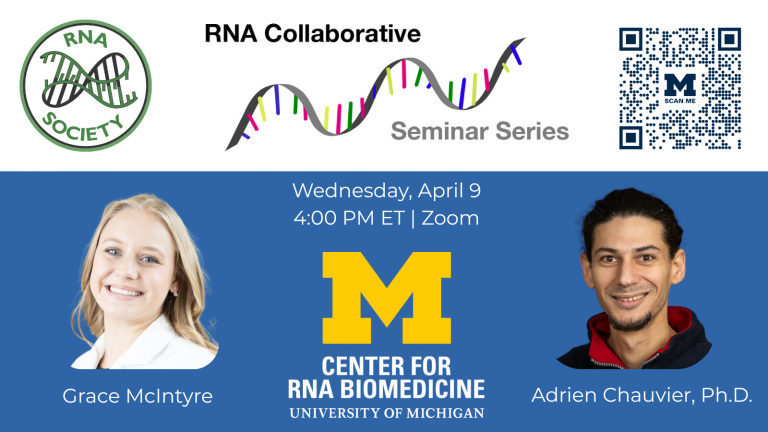
RNA Collaborative Seminar, Wednesday, April 9 at 4:00 PM ET on Zoom | Click here to see full details on event calendar. Video recording. UPDATE: 4.10.25 There was a fantastic Collaborative Seminar yesterday with talks by Grace McIntyre, Ph.D. Candidate, Michigan Medicine Department of Pathology, and Adrien Chauvier, Ph.D., Senior Scientist, Nils Walter Lab University…
Over half of our genomes are made of repeating elements within DNA. In rare cases, these repeats can become unstable and grow in size. These repeat “expansions” cause neurodegenerative diseases such as ALS and Dementia as well as learning disorders and autism in Fragile X syndrome. Research to date has focused on how these expanded…