
RNA Faculty Spotlight – Carlos Andres Aguilar, Biomedical Engineering
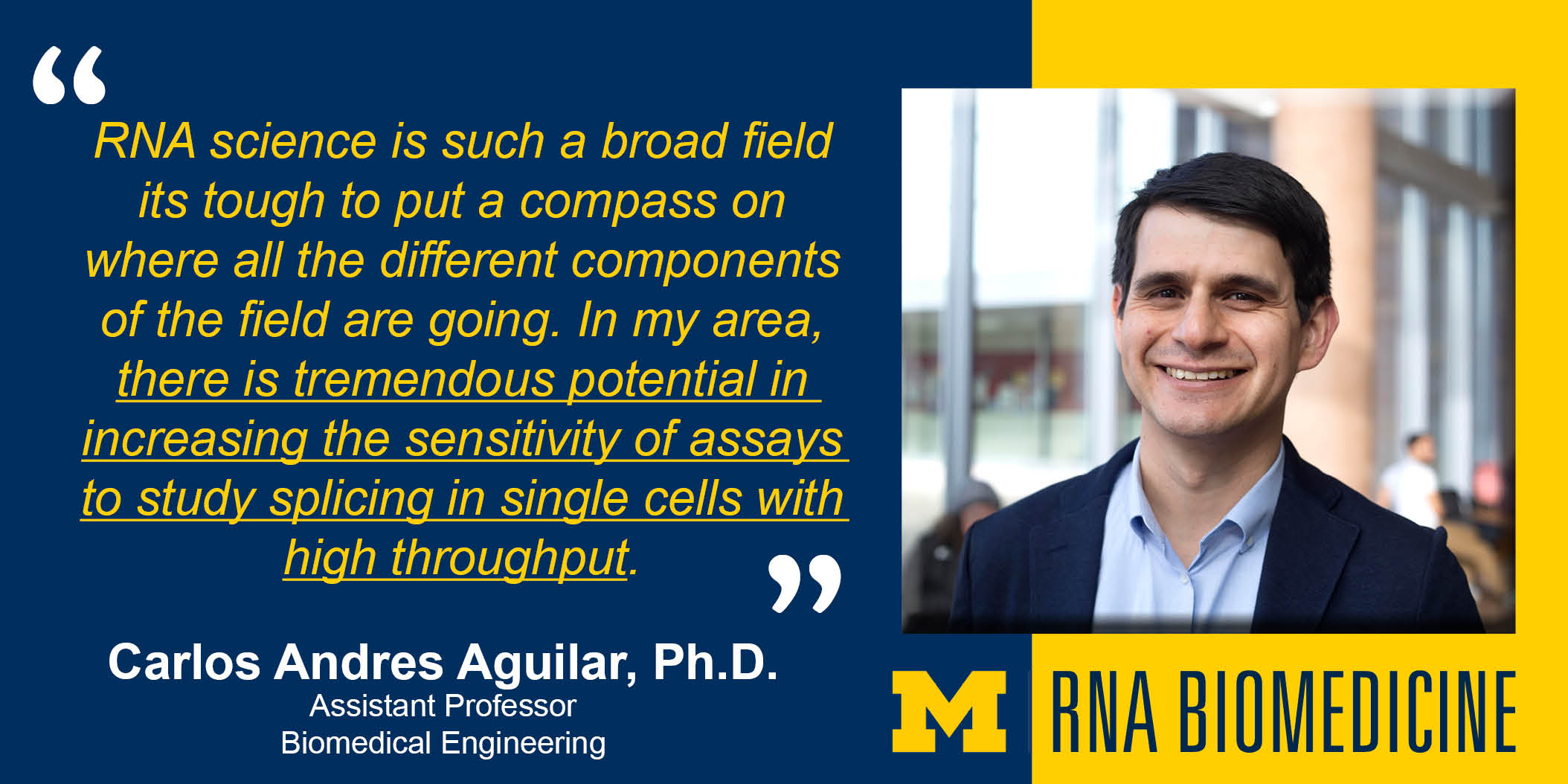
 

Carlos Andres Aguilar, PhD
Assistant Professor
Biomedical Engineering
College of Engineering

The long-term goal of the NOBEL  (nano-omic-bio-engineering-laboratory) is to make breakthroughs in medicine and biology that instill hope and inspire others. To accomplish this feat, we develop, optimize and apply innovative technologies such as integrative genomic assays and high-throughput sequencing, micro/nanofabricated devices, genome editing and computational modeling to our primary area of focus, which is skeletal muscle.
Visit Lab Website


  • What are your research interests? I am interested in the transcriptional and epigenetic mechanisms adult stem cells, particularly in skeletal muscle, use to regenerate tissue and defend against aging.


  • Who/what brought you to science? As an undergrad here at Michigan, I had a terrific mentor that galvanized my interest in biology, which led me to do research and then follow that into graduate school.


  • What advice would you give to students who’d like to get more involved in research? Dont be afraid to ask or volunteer to get involved with research, and don’t be shy to ask around for help in solving problems.


  • Are there any opportunities for students to engage in your projects, currently or in the future? Sure, we are always looking for motivated and bright students to help us in our laboratory. Our lab has active projects in different facets of muscle stem cell biology ranging from understanding chromatin in aging, plasticity of cell fate, interactions with other cell types and how noncoding RNAs change in response to injury.


  • What skills would they need, and what could they expect to learn? Basic biology and programming skills are general skills we look for in candidates. An interest in stem cells and skeletal muscle are also bonuses.


  • What profession other than your own would you like to attempt? National geographic photographer

Similar Posts

  • 2017-2018 RNA Seminars

    2017-2018 RNA Innovation Seminar Series RNA Innovation Seminars (6/18/18) Melani Ohi, Ph.D., Associate Professor of Cell and Developmental Biology, Research Associate Professor, Life Sciences Institute Using Cryo-EM to study RNA based molecular machines Jacob Kitzman, Ph.D., Assistant Professor of Human Genetics, Assistant Professor of Computational Medicine and Bioinformatics Massively parallel measurement of mutations’ functional effects RNA Innovation Seminars|| Theme: RNA viruses/retroviruses (6/4/18)  Andrew Tai, M.D.,…

  • |

    miR-181a, a microRNA that regulates ovarian cancer cells

    by Elisabeth Paymal One of the hallmarks of ovarian cancer is genomic instability resulting in gain and loss of DNA throughout the entire genome, including many microRNAs (miRNA). Dr. DiFeo, Ph.D., Associate Professor of Pathology and of Obstetrics and Gynecology at Michigan Medicine, and her team, research which miRNAs are involved in the early stages…

  • Our members’ promotions:

    Four Associate Professors and one Professor! The Board of Regents of May 21st, 2020, approved recommendations for new appointments and promotions for regular associate and full professor ranks of the University of Michigan. The following Center for RNA Biomedicine’s members were further appointed:   Sami J. Barmada, associate professor of neurology, with tenure, Medical School…

  • 2018-2019 RNA Seminars

      4th annual Toronto RNA Enthusiasts Day (TREnD) 7/30/19 (flyer) Keynote speaker: Dr. Tracy Johnson (UCLA) SickKids Peter Gilgan Centre for Research and Learning (686 Bay St, Toronto, Ontario) For more information visit: trendrna.com 2nd Conference on Biomotors, Virus Assembly and Nanobiotechnology 7/29/19  (flyer) Ohio State University, Cleveland OH For more information visit: rnanano.osu.edu/Guo/Biomotor2019/Biomotor2019.html ENCODE 2019: Research Applications and…

  • John Prensner honored with prestigious Damon Runyon Cancer Research Foundation award

    John Prensner, M.D., Ph.D., has received a Clinical Investigator Award from the Damon Runyon Cancer Research Foundation for his proposal: “Therapeutic opportunities and mechanistic insights of protein-RNA dyssynchrony in medulloblastoma.” The award supports outstanding early-career physician-scientists whose disease-oriented research has the potential to directly impact patients. Prensner was recognized as a leading pediatric cancer researcher…