

RNA Featured Researcher – Milan Samanta, Human Genetics
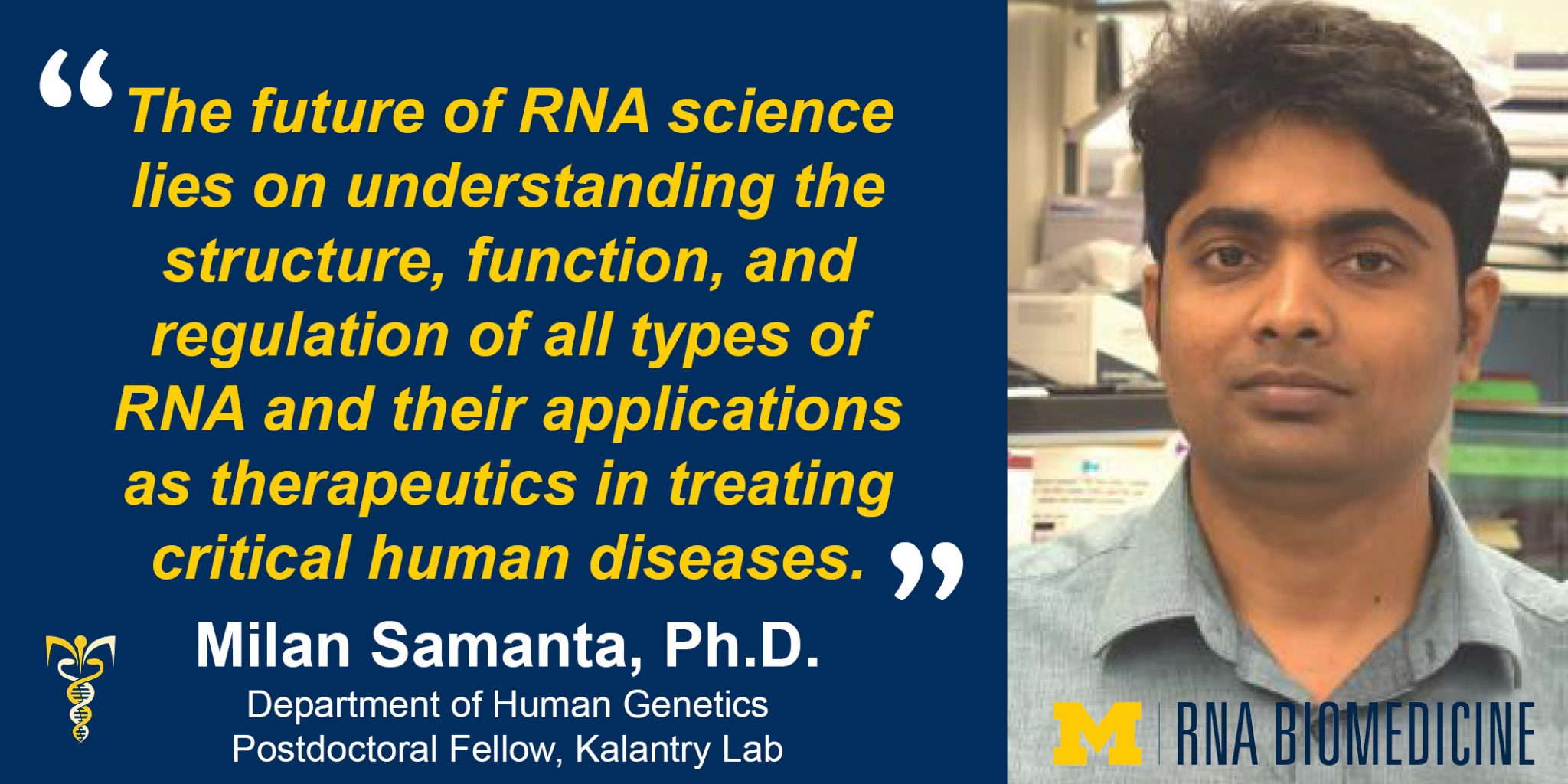
Milan Samanta
Posdoctoral Fellow, Kalantry lab
Department of Human Genetics
Google Scholar

Who/what brought you to science? Early on in my education, I was not very interested in science. This changed when I met my favorite professor, Dr. Rajesh Ali, while studying microbiology during my bachelor’s degree. Dr. Ali’s mentorship inspired me to peruse research in the biological sciences.

What are your research interests? I am interested in how epigenetic mechanisms regulate early developmental processes. It is fascinating how despite harboring the same genetic content, individual cells can take on distinct functions to generate an entire organism.

What do you hope is the outcome/impact of your research? I hope my research will advance the understanding of the gene regulation in very early development. Ultimately, I hope that the fundamental understanding of how gene regulation occurs could contribute to the treatment of human disease.

What advice would you give to students who’d like to get more involved in research? Find the area of research which inspires and motivates you and do work with patience.

What profession other than your own would you like to attempt? Sports: Tennis, Soccer, Cricket.

What are your longer-term career aspirations? My long-term carrier goal is to be a scientist in the field of developmental biology, and to apply my knowledge to treat human diseases.
 

Similar Posts

  • |

    U-M and multinational coalition of scientists reveal ribosome-RNA polymerase structural link to protein synthesis initiation in bacteria

    By Paul Avedisian 29 November 2024 An international consortium of researchers from the University of Michigan, the Université de Strasbourg, and the Technische Universität Berlin uncover important players in the mechanistics and the machinery involved in the bacterial ribosome-mRNA translation initiation process through an intercollegiate collaborative new study.  Adrien Chauvier, Ph.D., is a Senior Scientist…

  • “The CRISPR Craze: Scientific Breakthroughs Come to the Prepared when Least Expected”

    The 2020 Nobel Prize of Chemistry recognizes Emmanuelle Charpentier, Max Planck Unit for the Science of Pathogens, Berlin, Germany, and Jennifer Doudna, University of California, Berkeley, USA, “for the development of a method for genome editing.” Every year, the University of Michigan Complex Systems invites U-M faculty to comment about the Nobel Prizes awards. In…

  • RNA Faculty Spotlight – Markos Koutmos, Biophysics and Chemistry

    Markos Koutmos, Ph.D. Assistant Professor of Biophysics & Chemistry Markos Koutmos joined the Center’s Executive Committee in 2020. The Koutmos lab is interested in understanding how the 3D structure and dynamics of proteins and RNAs drive their biological function. His lab combines chemistry, biophysics and biology approaches to build a foundation of basic knowledge for…

  • Run into Grant Sprints!

    The Center for RNA Biomedicine is offering Grant Sprints. For more information, please contact Maria Stieve. Photo: Grant Sprint at the U-M Center for RNA Biomedicine, October 2019, clockwise from left to right, Elizabeth Tidwell, Markos Koutmos, Aaron Frank, Brandon Ruotolo, Varun Gadkari. Curiosity and passion lead scientists to their field of research, but a…

  • Translating from dissertation to dream job: a nascent RNA career

    Only a couple of weeks after defending her Ph.D. thesis in November, Sarah Owen, a graduate student in Chemical Engineering in Dr. Sunitha Nagrath’s lab, landed her dream job. “It all went very fast,” she explained, “I had a seven-hour zoom interview on Thursday, and they offered me the job the following Monday!” In January…

  • 2019 Symposium

    Foundational RNA Biosciences: From Discovery to Function Friday, March 29, 2019, 8:30am – 4:00pm University of Michigan, Biomedical Research Science Building, 109 Zina Pitcher The Center for RNA Biomedicine Symposium brings together national leaders of the scientific, medical and engineering communities working on recent advances of our understanding of RNA. It will provide a means…