Tracy Johnson, Ph.D. – Keynote speaker, 2021 RNA Symposium
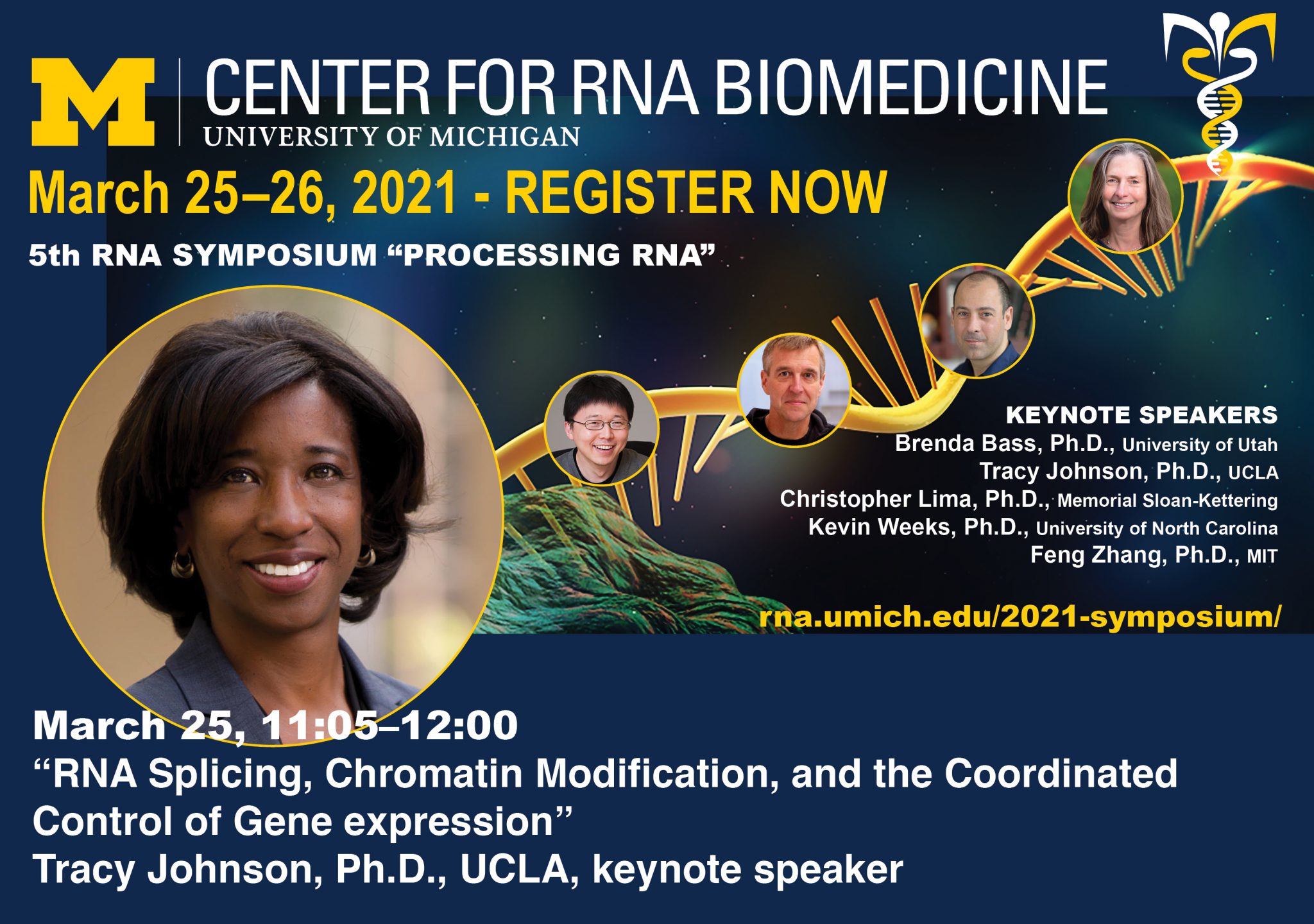
KEYNOTE SPEAKER 1: March 25, 2021, 11:05–12:00 pm
More information on the Symposium
Blog by MiSciWriters
“RNA Splicing, Chromatin Modification, and the Coordinated Control of Gene expression”
Tracy Johnson, Ph.D., University of California – Los Angeles
Keith and Cecilia Terasaki Endowed Chair in the Life Sciences
Professor of Molecular, Cell and Developmental Biology
Howard Hughes Medical Institute Professor
Dean, Division of Life Sciences
University of California – Los Angeles
The Tracy Johnson Lab
Twitter: @TheTracyLab
TALK ABSTRACT
Pre-messenger RNA splicing is carried out by the spliceosome, a dynamic ribonucleoprotein complex that is functionally conserved across eukaryotes. The spliceosome assembles onto pre-mRNA co-transcriptionally, raising important questions about how the process of transcription through a chromatin template influences spliceosome assembly and splicing outcomes. Furthermore, the close spatial and physical proximity of the splicing and transcription machineries raises the possibility of bi-directional regulation of these processes. Finally, regulation of spliceosome assembly and the fate of both spliced and unspliced RNAs provides an elegant mechanism for controlling gene expression. Understanding how these mechanisms are regulated in response to changes in the cell’s environment remains an important and exciting challenge. Here I will describe our recent insights into these questions.
REFERENCES
Leung, C., Douglass, S., Morselli, M., Obusan, M.B. Pavlyukov, M.S., Pelligrini, M., and T.L. Johnson. 2019. H3K36 methylation and the chromodomain-protein Eaf3 are required for proper co-transcriptional splicing. Cell Reports, 27(13):3760-3769.e4. PMID:31242410
Hossain, M.A.*, Claggett, J.C.* (*Co-first authors), Edwards, S.E., Shi, A., Pennebaker, S., Cheng, M. Hasty, J. and T.L. Johnson. 2016. Post-transcriptional regulation of Gcr1 expression and activity are crucial for metabolic adjustment in response to glucose availability. Molecular Cell 62:346-358. PMID: 27153533. PMCID: PMC5117908