
RNA Featured Researcher – Samantha Grudzien, Neuroscience Graduate Program
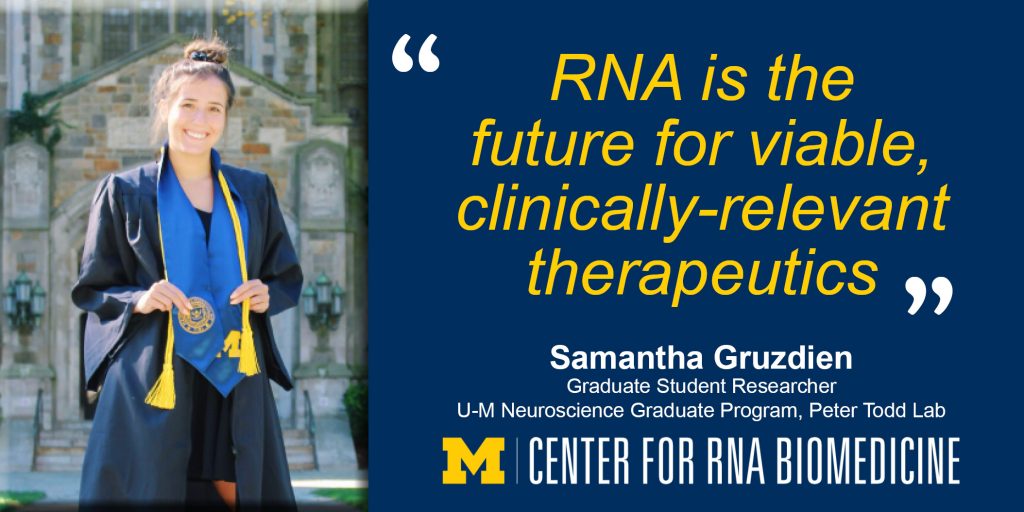
Samantha Grudzien
Graduate Student Researcher
U-M Neuroscience Graduate Program, Peter Todd Lab


Who/what brought you to science? Although not scientists, my mother has been in the medical field for over 30 years and my father has been a computer programmer. From their influence, I had an interest in STEM, and as I continued my education, my interest evolved into admiration. I am continuously inspired by the endless possibilities and questions that can only be asked and answered because of science.

What are your research interests? I am interested in how genetic variations drive neurodegenerative diseases. I work in the Todd lab, where we study microsatellite repeat expansion disorders (REDs) and repeat expansions can be throughout all regions of the gene (introns, exons, untranslated regions). Interestingly, the locations of these expansions that drive neurodegeneration can commonly be found in non-coding regions.

What do you hope is the outcome/impact of your research? In vivo mouse and complementary in vitro patient-derived data that provides rigorous evidence that will lead to clinical, RNA-based therapies for Fragile X-associated tremor/ataxia syndrome (FXTAS), the neurodegenerative disease I study.

What advice would you give to students who’d like to get more involved in research? Reach out to PIs and labs! On somewhat of a whim during my junior year at UMICH, I reached out to Dr. Samuel Kwon in MCDB because the research intrigued me, and I was offered a spot as a research technician. Ultimately, my time in Dr. Kwon’s lab in undergrad led me to pursue my PhD in Neuroscience here.

What profession other than your own would you like to attempt? To be a botanist and have my own climate-friendly conservatory that is open for everyone to enjoy.

What are your longer-term career aspirations? To have a job where I can explore my curiosities while also expanding the current breadth of knowledge in cellular and molecular neuroscience.

 

Similar Posts

  • S. Moon and N. Walter receive the CZI Collaborative Pairs Pilot Project Award

    ANN ARBOR, MI, AUGUST 19, 2020—”A pair” of scientists from the University of Michigan (U-M) Center for RNA Biomedicine receives the Chan Zuckerberg Initiative (CZI) Collaborative Pairs Pilot Project Awards. The U-M Center for RNA Biomedicine brought together two scientists for this highly competitive grant: principal investigator Stephanie Moon, Ph.D., Assistant Professor in Human Genetics,…

  • CRISPR to KLIPP cancer

    While most efforts involving CRISPR are focused on genome editing, the CRISPR machinery could also be used as a molecular weapon to slice up chromosomes of cancer cells. Research has shown that chromosomes may undergo a “catastrophic” event early in the process of carcinogenesis causing multiple breakages. While many cells die in such events, some…

  • 2017 Symposium

    “RNA in Precision Medicine” Read the Live Blog Check out our Symposium Video Featuring talented keynote speakers from across the world as well as six “mini-talks” presentations from across the University.   The Center for RNA Biomedicine Symposium brings together national leaders of the scientific, medical and engineering communities working on recent advances of our…

  • |

    Publication in Nature Neuroscience: Disease-causing Repeats Help Human Neurons Function

    Over half of our genomes are made of repeating elements within DNA. In rare cases, these repeats can become unstable and grow in size. These repeat “expansions” cause neurodegenerative diseases such as ALS and Dementia as well as learning disorders and autism in Fragile X syndrome. Research to date has focused on how these expanded…

  • LSA researcher Monica Dus named White House Fellow

    A University of Michigan researcher has been appointed a 2023-24 White House Fellow. Monica Dus, associate professor of molecular, cellular and developmental biology in LSA, was chosen through a highly competitive selection process for her efforts in communicating science to the public. Dus was placed with the Department of the Navy. “I am so honored…

  • John Prensner honored with prestigious Damon Runyon Cancer Research Foundation award

    John Prensner, M.D., Ph.D., has received a Clinical Investigator Award from the Damon Runyon Cancer Research Foundation for his proposal: “Therapeutic opportunities and mechanistic insights of protein-RNA dyssynchrony in medulloblastoma.” The award supports outstanding early-career physician-scientists whose disease-oriented research has the potential to directly impact patients. Prensner was recognized as a leading pediatric cancer researcher…