
RNA Featured Researcher – Michael McMillan, Cellular and Molecular Biology
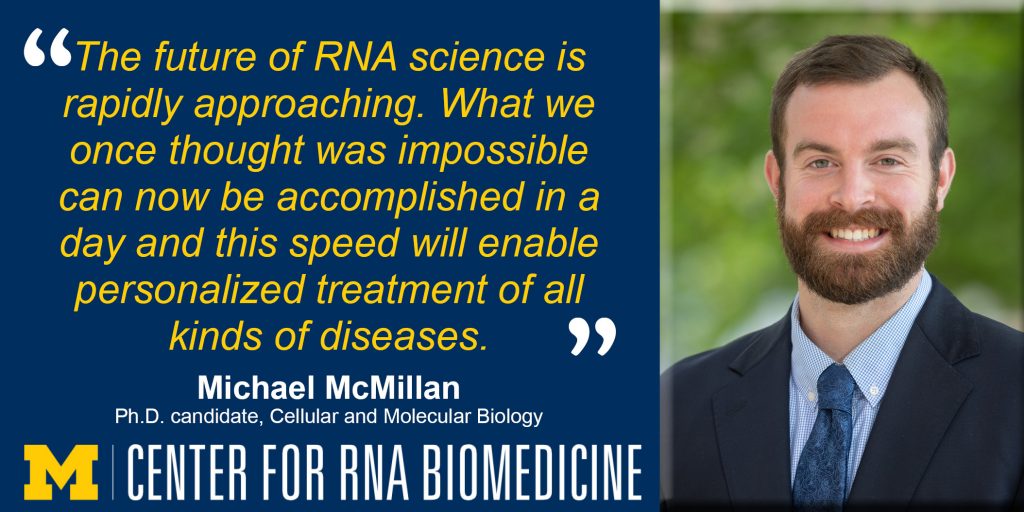
Michael McMillan
Ph.D. candidate
Cellular and Molecular Biology
Mentor: Dr. Sami Barmada

  • Who/what brought you to science?

I became interested in science during jr. high and high school after having three great teachers that promoted experimentation and thinking critically about science. I really enjoyed learning the intricacies of nature so I went on to study science further in college and now in grad school.

  • What are your research interests?

My research focuses on identifying molecular mechanisms of amyotrophic lateral sclerosis (ALS), a fatal neurodegenerative disease. Specifically within ALS I am focused on how RNA modifications influence RNA stability that may contribute to disease pathogenesis.

  • What do you hope is the outcome/impact of your research?

I hope that my research can open up new areas of investigation for creating therapeutics and provide some hope to those battling ALS.

  • What advice would you give to students who’d like to get more involved in research?

If you want to do research, contact as many PI’s as you can and find any opportunity to get involved. Even if it’s not your direct field of interest, you can learn skills that carry from lab-to-lab to make your skillset valuable in any lab you join.

  • What profession other than your own would you like to attempt?

If I wasn’t a scientist, I would love to be a chef. I cooked a lot during the lockdown, and used my new skills at football tailgates which were awesome and brought a bunch of people together to have a good time.

  • What are your longer-term career aspirations?

My long term goals are to carry my knowledge as an RNA scientist into the biotech industry and create life changing therapeutics for ALS patients.
Similar Posts

  • RNA Faculty Spotlight – Markos Koutmos, Biophysics and Chemistry

    Markos Koutmos, Ph.D. Assistant Professor of Biophysics & Chemistry Markos Koutmos joined the Center’s Executive Committee in 2020. The Koutmos lab is interested in understanding how the 3D structure and dynamics of proteins and RNAs drive their biological function. His lab combines chemistry, biophysics and biology approaches to build a foundation of basic knowledge for…

  • |

    U-M and multinational coalition of scientists reveal ribosome-RNA polymerase structural link to protein synthesis initiation in bacteria

    By Paul Avedisian 29 November 2024 An international consortium of researchers from the University of Michigan, the Université de Strasbourg, and the Technische Universität Berlin uncover important players in the mechanistics and the machinery involved in the bacterial ribosome-mRNA translation initiation process through an intercollegiate collaborative new study.  Adrien Chauvier, Ph.D., is a Senior Scientist…

  • 2016-2017 RNA Seminars

    RNA Innovation Seminars (6/8/17): Palmer Commons, Fourth Floor Forum Hall –Max Wicha, MD “Regulation of breast cancer stem cells by non-coding RNA’s” (Abstract, Flyer)   5/18/17 RNA Seminar Grill and Dahl Thurs, May 18, 2017: Michigan League – Michigan Room (2nd Floor) –Sheri A. Grill “The long and short of human TPP1” and Jan Dahl “The anti-inflammatory drug mesalamine targets bacteria polyphosphate accumulation” (Grill Abstract, Dahl Abstract, Seminar Flyer) Thurs,…

  • U-M Researchers Collaborate on $3 Million Grant to Treat Rare Forms of Cystic Fibrosis

    Center RNA Therapeutics Director Michelle Hastings, and faculty members Rachel Niederer and Alexandra Piotrowski-Daspit address the need for new treatment strategies, and the subsequent barriers that must be overcome for success, by working together as an interdisciplinary team with unique expertise in CFTR physiology, designing RNA therapeutics, identifying targetable regulatory sequences, and developing engineered delivery…

  • |

    For the Walter Lab, the proof is in the fluorescent pudding

    How do you prove, in a laboratory setting studying objects in size just one-thousandth of the diameter of a hair, that something is doing what it is designed to do? The Walter Lab at the University of Michigan is doing just that, through single-molecule fluorescence imaging and tracking, and recently for a tiny nano engine…